

Posts Tagged ‘holistic medicine’

Med Students Say Conventional Medicine Would Benefit by Integrating Alternative Therapies

Wednesday, February 10th, 2010

Newswise — In the largest national survey of its kind, researchers from UCLA and UC San Diego measured medical students’ attitudes and beliefs about complementary and alternative medicine (CAM) and found that three-quarters of them felt conventional Western medicine would benefit by integrating more CAM therapies and ideas.

The findings will be published in the online issue of Evidence-based Complementary and Alternative Medicine (eCAM) on January 20, 2010.

“Complementary and alternative medicine is receiving increased attention in light of the global health crisis and the significant role of traditional medicine in meeting public health needs in developing countries,” said study author Ryan Abbott, a researcher at the UCLA Center for East-West Medicine. “Integrating CAM into mainstream health care is now a global phenomenon, with policy makers at the highest levels endorsing the importance of a historically marginalized form of health care.”

CAM, which includes therapies such as massage, yoga, herbal medicine and acupuncture, is characterized by a holistic and highly individualized approach to patient care. It’s emphasis is on maximizing the body’s inherent healing ability; getting patients involved as active participants in their own care; addressing the physical, mental and spiritual attributes of a disease; and preventive care. While interest in these fields has increased dramatically in the United States in recent years, information about such therapies has not yet been widely integrated into medical education.

“Even with the high prevalence of CAM use today, most physicians still know little about non-conventional forms of medicine,” said study author Michael S. Goldstein, Ph.D., a senior research scientist at the UCLA Center for Health Policy Research and professor of Public Health and Sociology, UCLA. “Investigating medical students’ attitudes and knowledge will help us assess whether this may change in the future.”

The team of UCLA and UC San Diego experts in the fields of CAM, integrative medicine, Western medicine, medical education and survey development created a novel 30-question survey and sent it to 126 medical schools throughout the United States. In return, the team received 1,770 completed surveys from a pool of about 68,000 medical students nationwide, roughly three percent.

While the current results offer valuable insight into medical students’ perceptions of CAM, given the low response rate, researchers plan future studies to further refine the tool and see if the findings can be more generalized.

Researchers found that although medical students endorsed the importance of complementary and alternative medicine, obstacles remain that may prevent future doctors from recommending these treatments in their practices. According to the findings:

• 77 percent of participants agreed to some extent that patients whose doctors know about complementary and alternative medicine in addition to conventional medicine, benefit more than those whose doctors are only familiar with Western medicine.
• 74 percent of participants agreed to some extent that a system of medicine that integrates therapies of conventional and complementary and alternative medicine would be more effective than either type of medicine provided independently.
• 84 percent of participants agreed to some extent that the field contains beliefs, ideas, and therapies from which conventional medicine could benefit.
• 49 percent of participating medical students indicated that they have used complementary and alternative treatments however few would recommend or use these treatments in their practice until more scientific assessment has occurred.

“Our research suggests that persuading doctors to integrate CAM will require investment in the types of clinical research that form the backbone of Western medicine,” adds Abbott. “Even now, medical schools have the opportunity to train the next generation of medical practitioners in health care systems outside of conventional medicine. Core values of CAM can help students develop a more holistic and individualized approach to patient care.”

The study also found that the further along in school the student was, the more likely they were to believe their learning regarding CAM therapies was sufficient. Still, researchers note that more than 60 percent of participants favored more education related to this field during their time in medical school. Although more than half of all U.S. medical schools currently offer some type of CAM course, researchers say these courses could be augmented or streamlined into more formal, standardized curricula.

“Although the content of integrative medicine programs remains controversial, medical schools across the country are moving forward with ambitious new programs to teach the next generation of health care leaders,” said Dr. Ka Kit Hui, Wallis Annenberg Chair in Integrative East-West Medicine at UCLA, founder and director, UCLA Center for East-West Medicine, and chair, of UCLA’s Collaborative Centers for Integrative Medicine. “Through the Collaborative Centers for Integrative Medicine, UCLA has become one of the nation’s leading academic centers for integrative medical education. UCLA offers training programs for health sciences students and residents, as well as fellowships for clinicians and researchers.”

Hui added that the importance of integrative medical education is increasingly being realized outside of UCLA. Forty-four highly esteemed academic medical centers now comprise the Consortium of Academic Health Centers for Integrative Medicine, which was established to advance the principles and practices of integrative health care within academic institutions. It provides a community of support for academic missions and a collective voice for influencing change. The Consortium also helps disseminate evidence-based information on CAM, informs health care policy, and supports medical education.

The study was funded by the National Institutes of Health, the Gerald Oppenheimer Family Foundation, and the Annenberg Foundation.

Source: University of California, Los Angeles (UCLA), Health Sciences

This information is brought to you by Dr. XiPing Zhou, M.D.O.M., L.Ac. Dr. Zhou is founder & president of East West Healing Arts Institute Massage School, Dr. Zhou’s Acupuncture & Pain Management Clinic, Madison Family Wellness Community Clinic,  The Herbal Palace, & China Delight Tours. Visit anyone of these websites to learn about Chinese medicine and culture.

The facelift that cuts out need to go under the knife

Tuesday, January 19th, 2010

MANY PEOPLE turn to complementary therapies in search of a more holistic approach to their health, which examines mental, emotional and sometimes even spiritual aspects of their illness alongside their physical symptoms. Now, it seems that growing numbers are also going to complementary therapists for a more holistic approach to their beauty.

In the boom years, the acupuncture facelift became popular as a non-surgical method to improve beauty, radiance and vitality in the face while also promising to lift overall energy levels. Facial rejuvenation workshops enabled qualified acupuncturists to top up their skills and add acupuncture facelifts to their treatment portfolios.

Áine Delaney is an acupuncturist working in Galway city. She says that facial rejuvenation was very popular for a while, and although she still has clients who ask for it, the interest has tapered off somewhat. At a cost of €70 per session, clients were advised to have about 10 sessions but many now choose only to have one or two.

On her website, Delaney still promotes acupuncture facial rejuvenation. “It lifts sagging skin, improves complexion, reduces frown lines, improves muscle tone and stimulates circulation,” she says.

“The worse the client was, the better were the results. People who had let themselves go would show good improvements even after one or two treatments,” she says.

“The treatment balances the overall energetic systems of the body too and will help those who have poor sleep, painful periods, bowel or bladder problems and menopausal symptoms.”

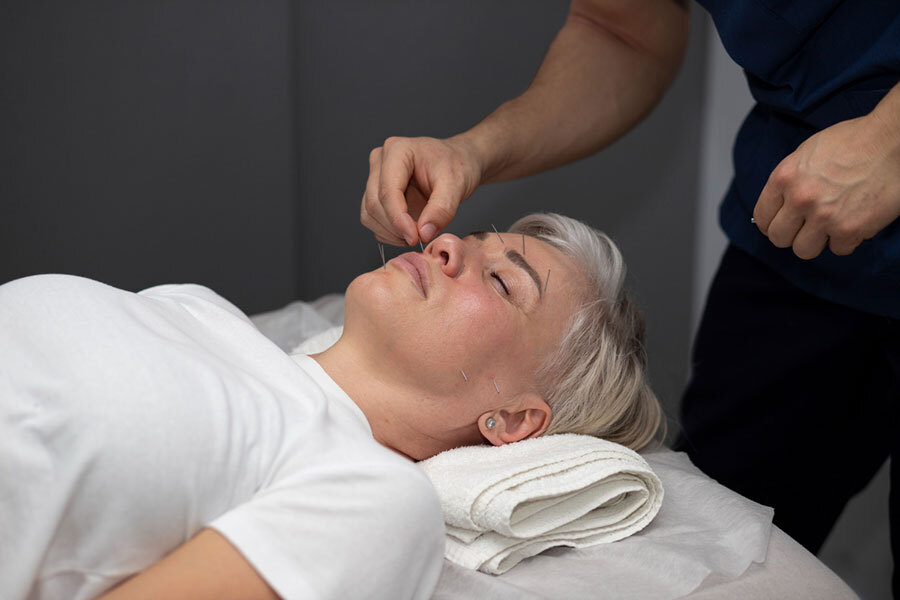
During facial rejuvenation or cosmetic acupuncture, fine needles are placed in specific areas of the face and body while the client lies in a relaxed position on a massage table. The needles are left in for at least 30 minutes.

Anne Marie Lally has been getting cosmetic acupuncture for about three years now. “I’ve quite a tense face and it helps plump up my face again and eases out the lines on my forehead,” she says.

“People say I look really rested and not as drawn looking after I have a session. My skin really glows and the effects last for about a week.”

Lally, who is in her 30s, has never had a series of acupuncture facial rejuvenation sessions, but instead goes from time to time before a special event or at Christmas time.

“It doesn’t hurt having the needles put into your face. Sometimes there would be a slight bruise for a few days but I wear make-up over it,” she adds. “I’d never go for a facial now because I would choose this instead.”

The Acupuncture Council of Ireland warns that facial rejuvenation acupuncture is not recommended for anyone with diabetes and high blood pressure. Pregnant women, those with pituitary disorders and migraine sufferers should also avoid it. It shouldn’t be given to anyone with a bout of flu, allergic reaction or a cold.

Holistic massage therapist Bernie Traynor has introduced an alternative natural facelift treatment that may suit those who don’t like the idea of needles in their faces. Based in the Dublin Naturopathic Centre, Traynor incorporates manual lymphatic drainage techniques, Indian head massage and acupressure into the treatment.

“I’m principally trained as a holistic massage therapist, but in holistic massage therapists tend not to go near the face and scalp, but I believe we hold a lot of tension in our scalps. I’ve added manual lymphatic drainage to the treatment because the lymphatic system can be sluggish for many people and gentle touching on the face can help get the lymph flowing again,” she adds.

Acupuncturists don’t claim to alter the face in ways that cosmetic surgery can, but there is plenty of anecdotal evidence to suggest that cosmetic acupuncture can rejuvenate skin and muscle tone.

With tightening budgets, these holistic facelifts may well become fashionable as the costs – and potential risks – of cosmetic surgery give way to gentler approaches to beauty.

NATURAL FACELIFT: HOW IT FEELS 

THE PROSPECT of a natural facelift in early January sounded very attractive. So, on a grim workday morning, I went along for the one-hour treatment. The idea was that at various meetings throughout the day and with my family later, I could gauge the results.

The treatment started with a 10-minute gentle neck and shoulder massage. Although the therapist mentioned that I had quite a bit of tension across my shoulders, she didn’t do any deep tissue work.

During the next 10 minutes or so, she gently touched various lymph nodes on my face, moving on to light pressure and gentle stretching movements on my chin, my eyebrows, my cheek bones and forehead.

She then massaged the scalp of my upper head, which I found to be the most enjoyable part of the treatment. In fact, I would have liked the head massage to have extended to the back of my head as well.

She ended the treatment with fluttering finger movements all over my face, which reminded me of someone playing the piano and seemed to echo the music that played in the background.

I felt my face looked clearer and more open immediately after the treatment and I noticed that a few small spots on my cheeks disappeared later that day.

However, not one person I met throughout the day commented on my face. It was the perfect qualitative piece of research: no one knew I was having a natural facelift, but no one noticed that I had had one.

As I turned in that night, I looked expectantly in the mirror again, only to conclude that a brisk walk or even a swim would have left more of a glow on my face.

http://www.irishtimes.com/newspaper/health/2010/0119/1224262627938.html

This information is brought to you by Dr. XiPing Zhou, M.D.O.M., L.Ac. Dr. Zhou is founder & president of East West Healing Arts Institute Massage School, Dr. Zhou’s Acupuncture & Pain Management Clinic, Madison Family Wellness Community Clinic,  The Herbal Palace, & China Delight Tours. Visit anyone of these websites to learn about Chinese medicine and culture.